



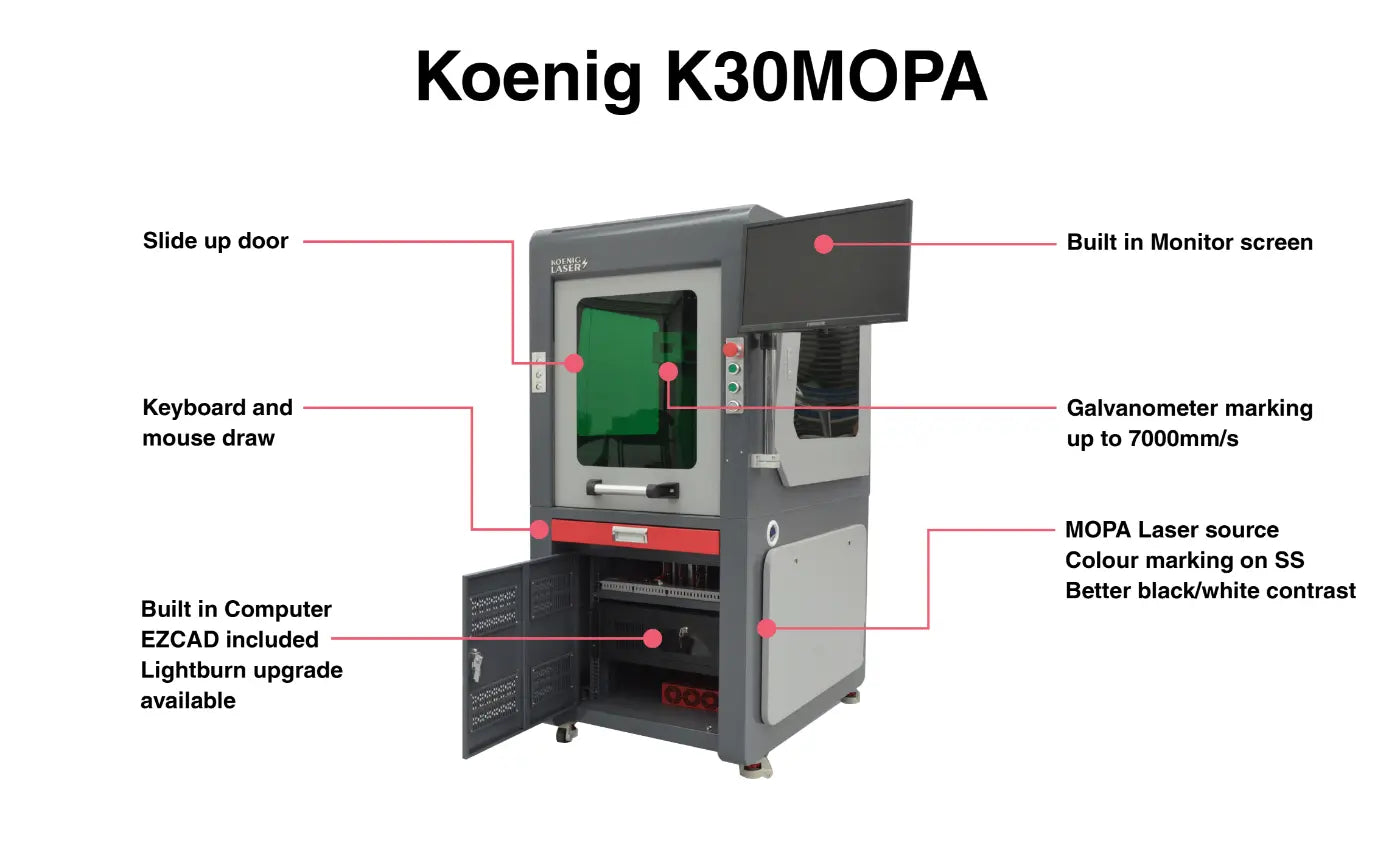


KOENIG K30MOPA
$13,950.00
*ex GSTThe Koenig MOPA fiber marking machine comes in a new heavy-duty frame, to withstand the busy and hectic factory floor. With 30W power as standard, the MOPA laser source is ideal for colour fiber marking onto Stainless steel, but it is not only colour that you will get out for your MOPA laser. The MOPA laser technology changes the marking process allowing you to control the wavelength during marking. This allowing for brighter white and darker black marking onto any metal surface. 3D/deep engraving can also be achieved, where higher power is recommended.
⚡ Get 10% Off Laser Materials… Forever!⚡
Automatically applied to your account with every Koenig Machine purchase. Explore our material range
Australian Based Local Support for Life
Setup & Training by Expert Local Technicians
10% Off Laser Materials for life on all Machines
10+ Years as the Aussie Laser Specialists


Specifications
| Specification | Detail |
|---|---|
| Laser Power | 30W / 50W / 80W / 100W |
| Safety Class | Class 1 enclosure |
| Marking Area | 300 x 300mm marking area greyscale, 175x175mm marking area for best colour marking |
| Max Marking Height | 40mm with 300x300mm lens, 200mm with 175x175mm lens |
| Laser Wavelength | 1064nm |
| Minimum Line Width | 0.02mm |
| Minimum Character | 0.15 x 0.15mm |
| Max Engraving Line Speed | 7000mm/s |
| Repeatability Accuracy | ±0.01mm |
| Re-positioning Accuracy | 0.02mm |
| Controlling Software | EZcad software provided, Lightburn software compatible |
| Graphic Format Supported | Graphics files – Ai, DXF, PLT, Gerber, etc. G code – MaterCam, Type3, Wentai etc. |
| Compatible Software Partners | Illustrator, Photoshop, CorelDraw, Autocad, Solidworks, MaterCam, Type3, Wentai etc. |
| Auxiliary Equipment | Inbuilt PC, monitor, keyboard draw, keyboard and mouse included, Inbuilt electrical cooling system |
| Power Supply | 230V, 50Hz, 10amp |
| Working Environment | Temperature:0-45C, Humidity 5-95%(No Condensate Water) |
| Machine Dimensions | 1200(W)*1100(D)*1780(H)mm |
| Weight | 270kg |
| Options | Chuck rotary device, air filtration unit |


Brochure
Koenig Machinery K30MOPA

KOENIG K30MOPA
$15,345.00
Set up and training does depend on your machine type and location. Depending on your own skill set and
ability to absorb our training material we have several options for you.
You can have one of our highly trained technicians to install your machine at your premises Australia wide.
However, if you’re rural and want to look at setting up the machine yourself, we have videos and guides to assist
you with the installation process.